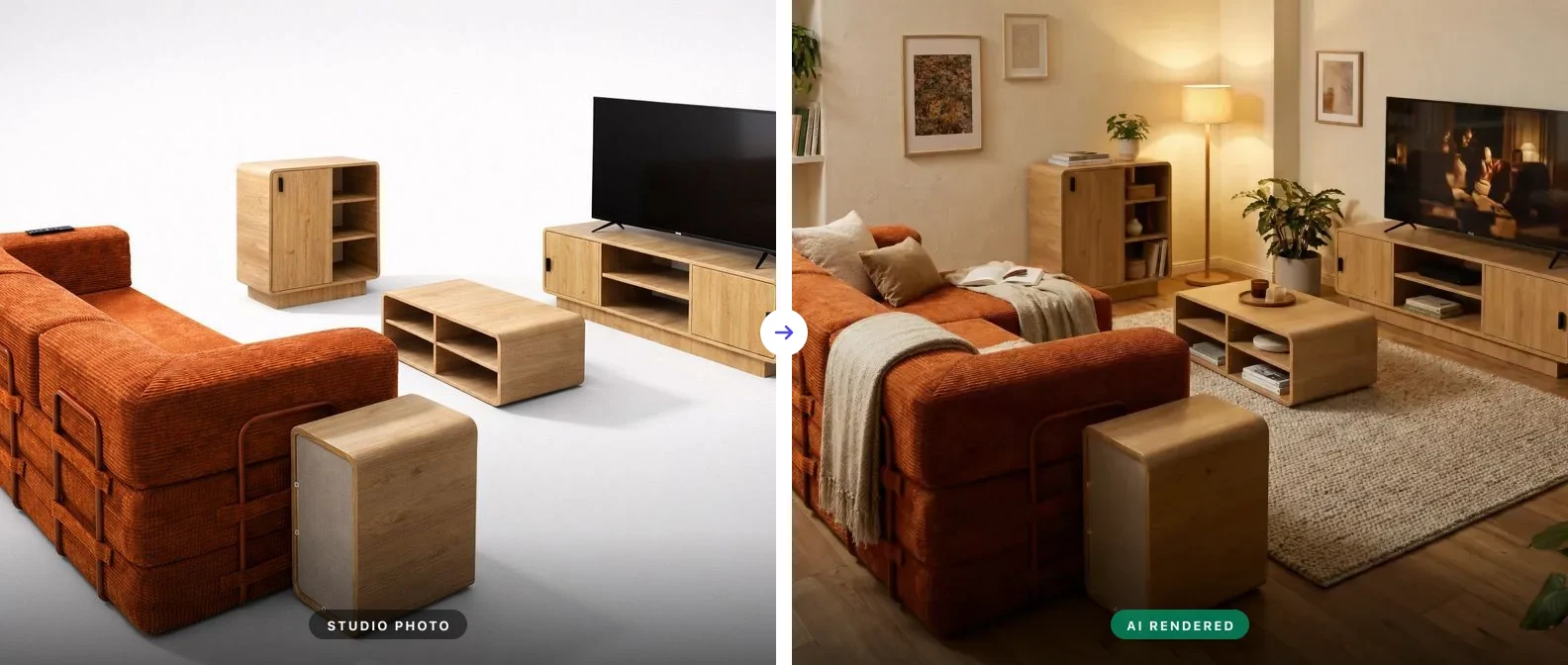
In 2024, the global furniture e-commerce market crossed $300 billion. By 2028, it's projected to reach $436 billion (Statista). That growth has created an acute bottleneck: every product listed online needs professional imagery, and traditional photography simply cannot scale to meet demand.
Enter AI rendering — the technology that generates photorealistic room scenes from a single product photo, without cameras, studios, or stylists. What started as an experiment in computer vision labs is now a production-ready workflow used by thousands of furniture sellers worldwide.
But not all AI rendering is created equal, and the technology's limitations matter as much as its capabilities. This article explains what AI furniture rendering actually is, examines the peer-reviewed research behind it, and breaks down why retailers across every channel — from Amazon to Shopify — are making the switch.
What Is AI Furniture Rendering?
AI furniture rendering uses generative AI models — specifically diffusion models and vision transformers — to create photorealistic images of furniture products placed in room environments. Unlike traditional 3D rendering (which requires a detailed CAD model, material definitions, and lighting setups), AI rendering works from a simple 2D photograph.
Product Isolation
The AI identifies the furniture piece in the input photo and separates it from any existing background. Advanced segmentation models detect precise object boundaries, including complex edges like wicker textures, tufted fabrics, and curved legs.
Scene Generation
A diffusion model generates a room environment around the product, informed by the user's selected style (Scandinavian, Modern, Industrial, etc.), lighting preferences, and camera angle. The model is conditioned on the product's visual properties — color palette, material type, scale — to produce a coherent scene.
Product Fidelity Preservation
This is where furniture-specific AI matters most. The model must preserve exact product details — colors, textures, proportions, material properties — while seamlessly integrating the product into the generated environment. Generic AI tools often fail here, subtly altering the product itself.
Output Refinement
The final image is upscaled to publication resolution (2K or 4K at 300 DPI), with lighting harmonization ensuring the product and room share consistent light direction, color temperature, and shadow behavior.
The result is a photograph-quality image that shows your product in a styled room — produced in under 60 seconds, from a single input photo. No 3D models, no CAD files, no rendering farm.
The Science Behind Visual Commerce
The shift to AI rendering isn't driven by novelty — it's driven by decades of research in visual perception, consumer psychology, and e-commerce analytics. Here's what the science says:
Visual Processing Dominance
The human brain processes images 60,000 times faster than text (3M Corporation / Zabisco research). In e-commerce, this means product images form the buyer's first impression — and often their final decision — before they read a single word of the description. For furniture, where tactile assessment is impossible online, visual information carries even more weight.
The Embodied Cognition Effect
Research published in the Journal of Consumer Psychology (Elder & Krishna, 2012) demonstrates that when consumers can mentally simulate using a product — seeing it in a context they recognize — purchase intention increases significantly. A sofa on a white background is an object. A sofa in a living room is a piece of someone's life. This cognitive reframing, called embodied cognition, is the mechanism that lifestyle imagery exploits.
The Mere Exposure Effect
Zajonc's mere exposure research (1968, replicated extensively) shows that familiarity breeds preference. When a shopper sees a product in multiple room contexts — a living room, a den, a modern loft — they develop familiarity with the product across scenarios, increasing preference and purchase confidence. AI rendering makes this kind of visual variety economically feasible for the first time.
of consumers say product photos are more influential than descriptions or reviews
Justuno E-Commerce Report
of furniture returns cite "looked different than expected" as the primary reason
Returnly / Loop Returns Data
average furniture return rate — the highest in e-commerce after apparel
NRF / Appriss Retail
The conclusion across all of this research is consistent: richer, more contextual product imagery reduces uncertainty, increases engagement, and drives conversion. The only barrier has been the cost of producing that imagery at scale — which is exactly what AI rendering eliminates.
Why Retailers Are Switching: The Economics
Understanding the psychology is important. But for retailers, the decision to switch ultimately comes down to economics. Here's a side-by-side analysis of what the transition actually looks like:
Cost Comparison: 100-Product Catalog
| Cost Factor | Traditional Photography | AI Rendering |
|---|---|---|
| Photographer + stylist | $15,000–$40,000 | $0 |
| Studio rental + set design | $5,000–$15,000 | $0 |
| Post-production editing | $3,000–$8,000 | $0 |
| Logistics (moving furniture) | $2,000–$5,000 | $0 |
| AI rendering platform | $0 | $50–$200 |
| Timeline | 3–6 weeks | 1–2 days |
| Total per catalog | $25,000–$68,000 | $50–$200 |
Based on industry averages for lifestyle photography with 3–5 images per product. AI rendering costs based on OmniRoom credit pricing.
The cost reduction is not 50% or even 90% — it's 99%+. But cost alone doesn't explain the switch. Retailers are also driven by three operational advantages:
Speed to Market
A new product can go from unboxing to fully staged listing in under 30 minutes. For seasonal collections, flash sales, or trend-driven launches, this speed is a competitive weapon. Traditional photography introduces 3–6 week delays that can miss entire selling windows.
Infinite Variation
The same product can be rendered in Scandinavian, Modern, Industrial, Bohemian, Coastal, and Minimalist room styles — from one photo. This lets sellers A/B test which room context converts best for each product, or target different customer segments with different aesthetics.
Catalog Consistency
When you photograph 100 products across 6 months with different photographers and studios, visual consistency suffers. AI rendering produces uniform quality, lighting, and style across your entire catalog — which builds the professional, trustworthy appearance that marketplaces reward with better placement.
Why Furniture Needs Specialized AI — Not Generic Tools
A critical distinction that retailers learn quickly: general-purpose AI image generators are not the same as furniture-specialized rendering tools. Tools like Midjourney, DALL-E, or generic product photography AI can produce impressive images — but they consistently fail on the specific challenges furniture presents:
Generic AI vs. Furniture-Specialized AI
- Alter product colors — a navy sofa may become teal or gray
- Distort proportions — legs too long, cushions too thin, arms misaligned
- Flatten material textures — velvet looks like plastic, wood grain disappears
- Unrealistic room scale — furniture looks too big or too small for the space
- Inconsistent results across multiple generations of the same product
- Preserves exact product colors, textures, and material properties
- Maintains accurate proportions — built with furniture dimensional awareness
- Material-aware rendering — leather, velvet, wood, marble handled correctly
- Architecturally coherent rooms with realistic spatial relationships
- Consistent product representation across every generated scene
OmniRoom is the only AI rendering platform built exclusively for furniture sellers and manufacturers. This isn't a generic tool with a "furniture mode" — it's a product designed by a team with 20 years of furniture visualization expertise, from the ground up. Every model, every room template, every material rendering pipeline was built to solve furniture-specific problems that general-purpose AI doesn't even recognize as problems.
This specialization matters commercially. Marketplace listings with accurate product representation generate 23% fewer returns (Narvar) — and each avoided furniture return saves $50–$150 in reverse logistics costs. The color drift and proportion distortion that generic AI tools introduce don't just look bad — they cost money in returns, refunds, and damaged seller ratings.
The Conversion Evidence: What the Data Shows
Retailers don't switch production workflows based on theory. They switch based on results. Here's what the aggregated data shows when furniture sellers move from white-background-only listings to AI-rendered lifestyle imagery:
Conversion Rate
Shopify merchants with lifestyle images
Time on Product Page
Average across furniture categories
Click-Through Rate
Search results and category pages
Return Rate
When expectations match reality
Sources: Shopify Commerce Report, Salsify Visual Commerce Study, BigCommerce Product Page Analysis, Narvar Consumer Survey
The return rate reduction deserves special attention. Furniture has one of the highest return costs in e-commerce — averaging $100–$200 per return for large items when you factor in shipping, inspection, restocking, and potential damage. A 25% reduction in return rate across a 500-product catalog can save a retailer $50,000–$150,000 annually — often more than the entire cost of the AI rendering platform.
This creates a compounding ROI: AI rendering costs less to produce, converts better, and generates fewer costly returns. The payback period for most furniture retailers is measured in days, not months.
Marketplace Trends: How Platforms Are Encouraging the Shift
It's not just sellers driving this change — the marketplaces themselves are actively rewarding richer visual content:
Amazon
Amazon's A+ Content program gives sellers with lifestyle imagery 5–10% higher conversion rates. Their algorithm also factors image count and quality into search ranking. Sellers using AI-rendered lifestyle images alongside white-background main images report measurably better organic placement.
Wayfair
Wayfair's "View in Room" AR feature has trained their customer base to expect contextual imagery. Sellers without lifestyle images are effectively invisible in Wayfair's curated style guides and "Shop the Look" features — which drive a significant share of discovery traffic.
Etsy
Etsy's search algorithm explicitly rewards listings with 10 images — the maximum allowed. Sellers who fill all 10 slots with varied, high-quality imagery (including lifestyle shots) see 2–3x more organic traffic than those with 3–4 images. AI rendering makes filling all 10 slots economically practical.
Shopify / DTC
For direct-to-consumer furniture brands, product page imagery is the brand. Shopify's own research shows that product pages with 8+ images including lifestyle shots convert 2x better than those with 3–4 white-background images. AI rendering enables this visual depth without the production overhead that traditionally limited it to well-funded brands.
The message from every major marketplace is clear: more visual content, more context, more angles. The platforms are optimizing for rich imagery because their data shows it drives sales. Sellers who can produce this content efficiently gain a structural advantage in organic visibility.
Getting Started with AI Furniture Rendering
For retailers considering the switch, the transition is straightforward. OmniRoom — built exclusively for furniture sellers by a team with two decades of furniture visualization experience — is designed to slot into your existing workflow:
Start with your best sellers
Upload your top 10 products — even basic manufacturer photos work. Generate 3–5 room styles per product and compare them to your existing listings. The conversion difference is usually visible within the first week.
Expand to your full catalog
Once you've validated the conversion impact, roll AI rendering across your entire catalog. With OmniRoom's batch workflows and consistent styling, a 200-product catalog can be fully staged in a single day.
Integrate into your launch process
Make AI rendering a standard step in your product launch workflow: receive product, photograph, render lifestyle scenes, publish. New products go live with full visual content from day one — no photo shoot scheduling, no 3-week delays.
The retailers who have already made this switch aren't going back. The economics are too compelling, the quality is proven, and the competitive advantage of speed-to-market compounds with every new product launch.
Selling wholesale rather than direct? The same economics apply at catalog scale — see our guide to AI catalog imaging for B2B furniture manufacturers and wholesalers.
See AI furniture rendering in action
Upload a product photo and generate your first lifestyle scene in under 2 minutes. Experience the only AI rendering platform built exclusively for furniture.
Try OmniRoom FreeRelated reading: What 36,000 AI-staged images taught us · Best AI furniture staging tools compared