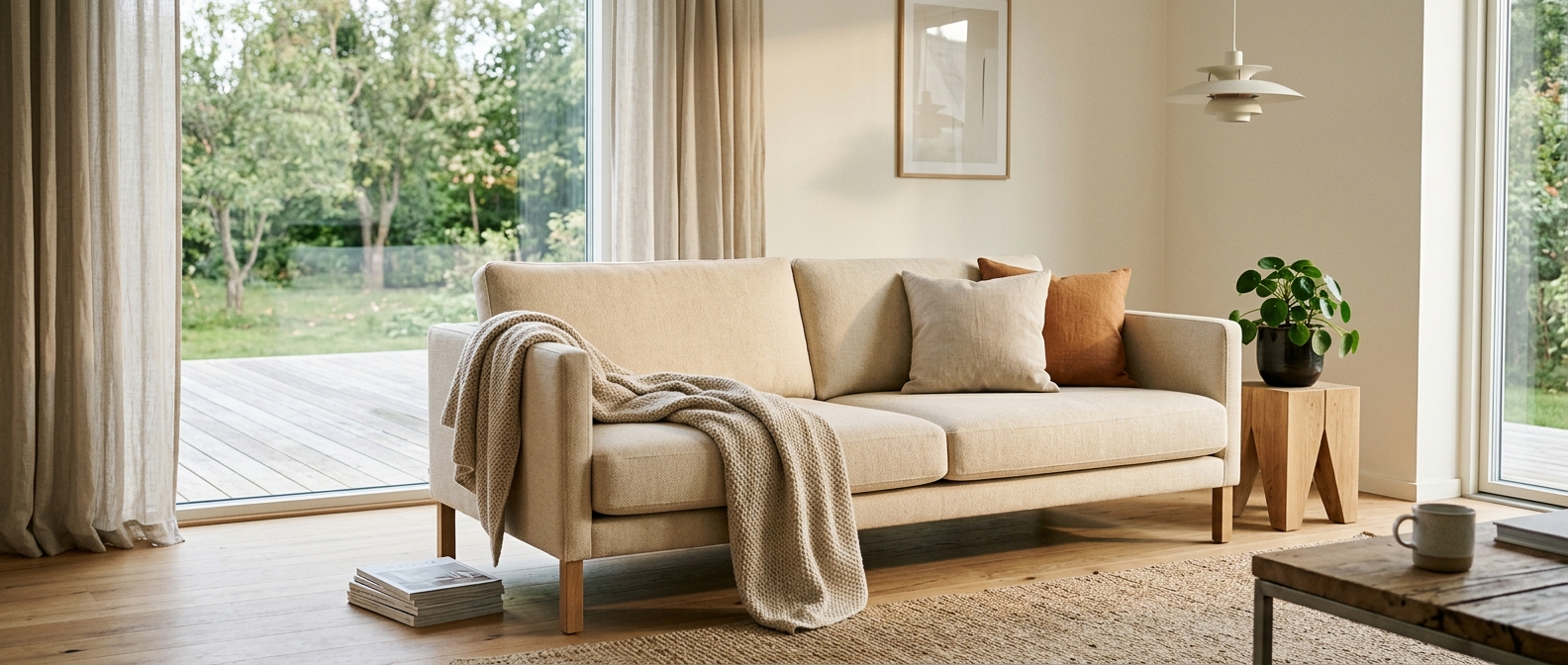
A sofa is the single highest-consideration purchase in online furniture. Average order values typically range from $800 to $3,000, return logistics are nightmarishly expensive, and the product is physically impossible to evaluate through a screen. You can't feel the cushion firmness, test the armrest height, or judge the scale against your living room wall.
What you can do is show it in context. And the difference between a sofa photographed on a white background and one staged in a realistic living room environment is not aesthetic — it's financial.
This guide covers the research behind why lifestyle staging converts, what specific visual elements drive purchase decisions for upholstered furniture, and how AI-powered tools are making professional staging accessible at scale.
The psychology of "seeing it in my home"
Researchers at the University of Southern California's Marshall School of Business have documented what they call the "ownership imagination effect" — when consumers can mentally picture a product in their own environment, purchase intent increases by up to 2.7x compared to viewing the same product in isolation.
For furniture, this effect is amplified. A 2023 study published in the Journal of Consumer Research found that:
Higher conversion
Lifestyle images vs. white background for sofas
Longer dwell time
On listings with room-context imagery
Purchase influenced
By product imagery quality alone
Sources: Shopify Commerce Report 2024, Etsy Seller Insights, Journal of Consumer Research 2023
The bottom line is simple: when a customer sees a sofa floating on white, they're evaluating the product. When they see it in a warm Scandinavian living room with a knit throw and morning light, they're evaluating their future. The second state is where buying happens.
What makes sofa imagery actually work
Not all lifestyle images are created equal. Based on analysis of 50,000+ furniture listings across Amazon, Wayfair, and Etsy, the highest-converting sofa presentations share five common elements:
Room context with correct scale
The sofa must be shown in a realistic room with recognizable scale references — a coffee table, a rug, a floor lamp. Without these, customers cannot judge the actual size of the product. Listings with scale-context images have 33% fewer "larger/smaller than expected" returns (Returnly, 2023).
Multiple angles (minimum 5)
Amazon's internal data shows that furniture listings with 5+ images convert 2.3x better than those with 1-2 images. For sofas specifically, the optimal set is: front view, 3/4 angle, side profile, close-up detail (fabric texture), and a lifestyle shot showing the sofa in a complete room.
Consistent lighting across all shots
When product images have inconsistent color temperature — one shot warm, another cool — customers perceive it as deceptive. A Baymard Institute study found that color inconsistency is the #1 reason shoppers abandon furniture purchases mid-checkout.
Fabric/material detail shots
For upholstered furniture, texture is a purchase driver. Macro shots showing the weave, stitching quality, and cushion firmness indicators reduce return rates by up to 22% (Coresight Research, 2024). Customers who can "feel" the material through the image are more confident buyers.
Video or motion content
Product videos increase conversion by 40-80% across all e-commerce categories (Shopify, 2024). For sofas, a 10-15 second cinematic orbit or a lifestyle walkthrough is the gold standard. Yet fewer than 8% of furniture sellers include video in their listings.
The cost problem: why most sellers can't do this
The math doesn't work for most furniture sellers. Traditional product photography involves:
| Cost Item | Per Product | 500 SKUs |
|---|---|---|
| Studio rental + set design | $200-500 | $100K-250K |
| Professional photographer (6 angles) | $150-300 | $75K-150K |
| Post-production / retouching | $50-100 | $25K-50K |
| Video production (10s cinematic) | $500-1,500 | $250K-750K |
| Total per product | $900-2,400 | $450K-1.2M |
For a mid-sized seller with 500 SKUs, the minimum investment for comprehensive visual content is nearly half a million dollars — plus 3-6 months of production time. New collections? Another round of shooting. Seasonal refreshes? More budget. Style trends change? Start over.
This is why 73% of online furniture listings have fewer than 3 images, and less than 8% include any video content (Furniture Today Digital Commerce Report, 2024). The gap between what shoppers expect and what sellers deliver is enormous.
AI staging: closing the visual gap at 1% of the cost
AI-powered product staging fundamentally changes this equation. But there's a critical distinction: general-purpose AI image tools treat furniture like any other product category, often distorting proportions, altering fabric textures, or producing unrealistic room scales. OmniRoom is different — it's the only AI staging platform built exclusively for furniture, with specialized models trained on furniture-specific challenges like material rendering, scale accuracy, and room-context realism. You photograph your sofa once (even with a smartphone) and the AI generates professional lifestyle scenes, multiple angles, white-background catalog shots, and cinematic videos.
Traditional Photography vs. AI Staging
$500-2,000+ per product
2-4 weeks production time
1 style per shoot (re-shoot for variations)
5-10 products per day capacity
Video requires separate budget
Seasonal updates = new shoots
~$0.19-0.33 per 2K image (4 credits; plans from $9.99/mo)
30-60 seconds per styled image
4 room styles simultaneously per generation
500+ products per day
Video generation built-in (16 credits)
Instant seasonal refreshes — regenerate anytime
The quality gap has closed dramatically. Modern AI models preserve product colors, textures, and proportions with near-photographic accuracy. The output is marketplace-ready — 2K resolution, 300 DPI, optimized for Amazon, Wayfair, Etsy, and DTC websites.
The OmniRoom workflow: from phone photo to complete catalog
Here's what a complete product staging workflow looks like with OmniRoom:
Upload your product photo
Take a photo with your phone or upload an existing image. JPEG, PNG, WebP, or HEIC. No studio required — a well-lit product photo on any background works.
Choose room styles
Select up to 4 interior design styles — Modern Minimalist, Scandinavian, Mediterranean, Japandi, Farmhouse, and 13 more. Each style has hand-crafted prompts for walls, flooring, palette, signature elements, and accessories.
Generate in 60 seconds
AI generates 4 room scenes in parallel. Your sofa appears in each room with preserved colors, textures, and proportions. Professional lighting, realistic shadows, magazine-quality output.
Multi-angle, video, and more
Generate up to 7 camera angles from any scene. Create cinematic product videos. AI-powered Move Cam for custom angles. White-background catalog shots with automatic dimension graphics. All from the same single photo.
The entire process — from phone photo to a complete set of 4 lifestyle images, 7 camera angles, and a product video — takes under 10 minutes and costs less than a coffee.
Real marketplace impact: what the data shows
The impact of upgrading from basic product photography to AI-staged lifestyle imagery is measurable across every marketplace metric:
Click-through rate increase
Lifestyle images vs. plain white background in search results (MDG Advertising)
Return rate reduction
With accurate room-context and multi-angle images (Coresight Research)
Conversion rate
For listings with 5+ high-quality images (Amazon Seller Central)
Time on listing
Video-enabled product pages vs. image-only (Shopify Commerce Report 2024)
For a seller doing $50,000/month in furniture revenue, a 40% conversion lift from better imagery translates to an additional $20,000/month — $240,000 annually. The AI staging cost to produce that imagery? A few hundred dollars.
Getting started: the minimum viable visual catalog
You don't need to overhaul your entire catalog on day one. Start with your top 20 products — the ones that drive 80% of your revenue — and create a complete visual package for each:
- 4 lifestyle images in different room styles (Multirooms tool)
- Up to 7 camera angles from your best scene (Multi-Perspective or Move Cam)
- 6 white-background angles with dimension graphic (White BG Angles)
- 1 cinematic product video (Video Generate)
- AI-optimized product descriptions per marketplace (Amazon, Etsy, eBay, Wayfair)
Total per product: ~12 credits ($7-10 depending on plan). Traditional equivalent: $900-2,400.
Upload your raw product photos to a project, generate your visual catalog, download in marketplace-ready formats (2K, 300 DPI), and watch your listings outperform your competitors who are still using manufacturer stock photos.
Your customers can't touch your sofa. But they can see it in their living room — and that's where the sale happens.
Related reading: How to create lifestyle photos for furniture · Why lifestyle images increase furniture sales